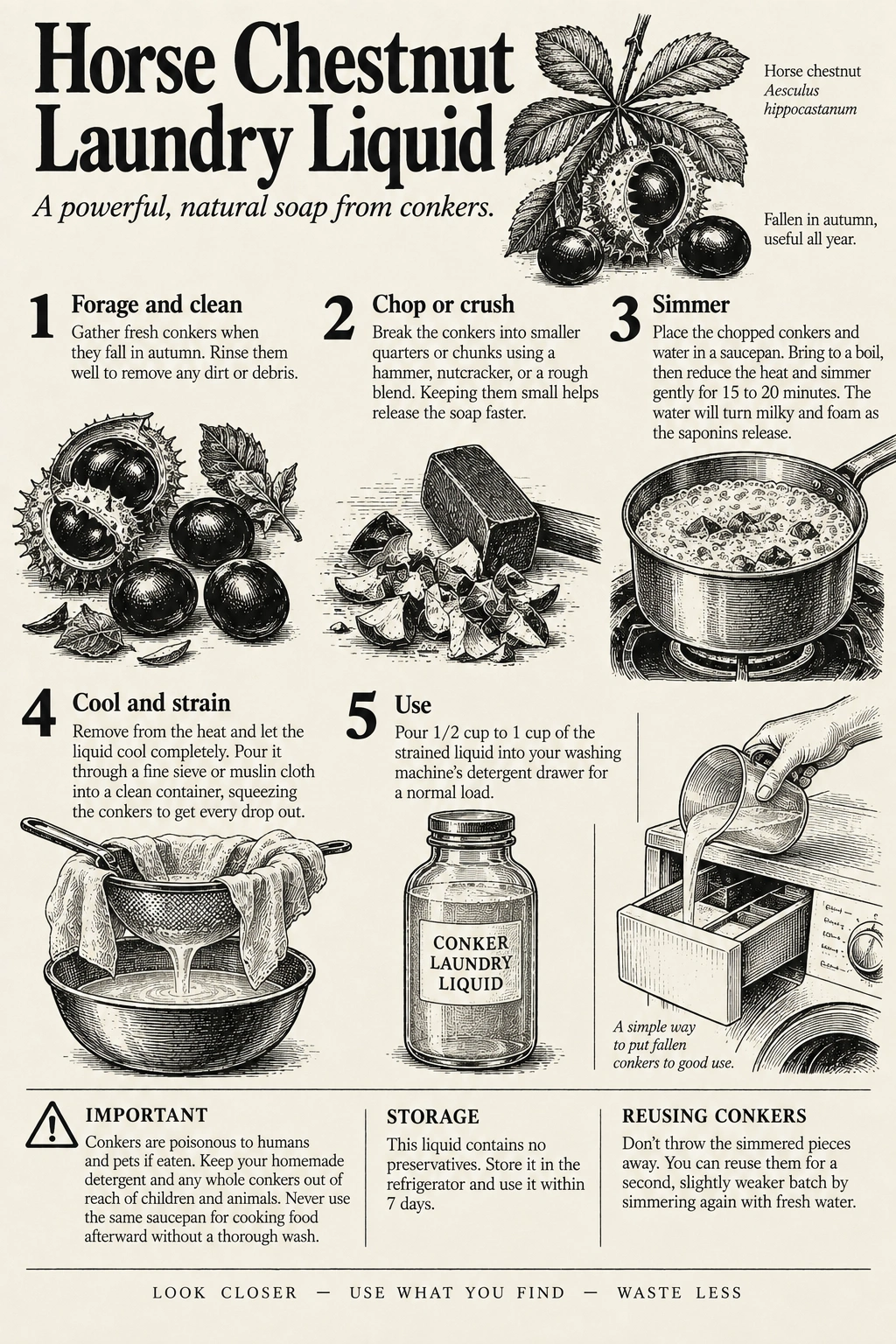
Every autumn, conkers fall in their thousands. We gather them, turn them over in our hands, admire that polished mahogany sheen, perhaps slip one into a pocket, and leave the rest to the squirrels and the leaf litter.
The horse chestnut (Aesculus hippocastanum) is not, of course, a native. It came to Britain from the mountains of the Balkans around 1616. Its story in print begins some sixty years earlier, in 1557. That year Willem Quackelbeen, physician to the imperial ambassador Ogier Ghiselin de Busbecq, wrote from Constantinople to the Italian physician Pietro Andrea Mattioli (1501–77). He described a chestnut the locals called ‘horse’, because a few of the nuts eased horses troubled by coughs and chest complaints.
The tale reached English readers in John Gerard’s Herball of 1597, a book built largely on the work of the Flemish botanist Rembert Dodoens. Gerard never saw the tree growing here, and whether the horses were ever much helped is another matter. But the name has stuck.
The seeds are rich in saponins, a group of compounds (aescin chief amongst them) that behave in water rather like soap. They lower the surface tension of the liquid, and they lather. It is the same property that gives soapwort (Saponaria officinalis) its long history in the washing of wool and delicate cloth.
Chop the conkers, simmer them gently, and these compounds pass into the water. The liquid turns cloudy, a pale milky colour, and may begin to foam at the edges of the pan. Once cooled and strained, it can be used for washing clothes. For my taste, it works best on everyday cottons; I personally would test it on a hidden seam before trusting it with anything precious, as the brown skins can tint the water. Peeling them first avoids this.
Gather a handful of freshly fallen conkers and take them home. Cut them into small pieces (a sturdy knife helps; they are harder than they look), add them to a saucepan of water, and simmer for fifteen to twenty minutes.
Watch what happens as they cook. Before using the strained liquid, pour a little into a jar and give it a good shake.
A note on safety: conkers are toxic if eaten and must never be confused with the sweet chestnut, Castanea sativa. Keep the liquid, and the raw nuts, well away from children and dogs.