For most of human history, nobody tried to warm a whole room. Central heating shapes our winters so completely that this is easy to forget, yet raising the temperature of every cubic foot of air in a house is a recent habit. Earlier households heated people rather than buildings, a distinction Kris De Decker has explored at length in Low-tech Magazine (2015), and they managed it with considerable skill.
Air holds heat poorly, and warm air rises, so much of what a modern boiler produces collects near the ceiling, above the heads of the people it is meant to serve.
A resting adult gives off roughly 100 watts of heat in keeping the core at around 37°C, which makes the winter problem one of holding on to warmth as much as producing it. Clothing slows the escape of body heat by trapping a thin layer of still air against the skin.
In 1941 the American physiologists Gagge, Burton, and Bazett proposed a unit for measuring this insulation, the clo. One clo is roughly what a three-piece business suit provides, enough to keep a seated person comfortable at about 21°C.
De Decker worked through what this means in practice. By his calculations, each additional 0.18 clo of clothing allows the room temperature to fall by about 1°C with no loss of comfort. A set of thermal long johns and a vest might bring a comfortable room down to around 17°C; two sets beneath ordinary clothes, he suggests, could take it as low as 12.7°C. These figures come from modelling, of course, and people vary a great deal in how they feel the cold. Anyone with a jumper and a thermostat can test them at home.
How much money this saves is harder to pin down. Heat loss from a house depends on the gap between indoor and outdoor temperatures, and a common rule of thumb puts the saving at somewhere between 6 and 10 per cent of heating costs for each degree taken off the thermostat. A drop of three or four degrees is therefore worth having, though the very large savings sometimes claimed for dressing warmly should be treated with caution. Warm clothing on the torso has another effect. When the core is well insulated, the body is less inclined to restrict blood flow to the hands and feet (a reflex known as peripheral vasoconstriction), so the extremities tend to stay warmer too.
Before central heating, warmth in a house gathered in particular places, and the hearth was chief among them. A good deal of furniture was designed around it.
An open fire heats unevenly, roasting one side of the body while the other stays cold, a condition now called radiant asymmetry. The hooded chair, sometimes called a porter’s or watchman’s chair, answered this with a high back and enclosing sides, often lined with leather or fabric, which kept draughts off the sitter and held the fire’s warmth around them. Folding screens did similar work around a dining table or writing desk. The curtained four-poster bed made a small enclosed room at night, keeping the sleeper’s own heat close against the chill of an unheated bedchamber.
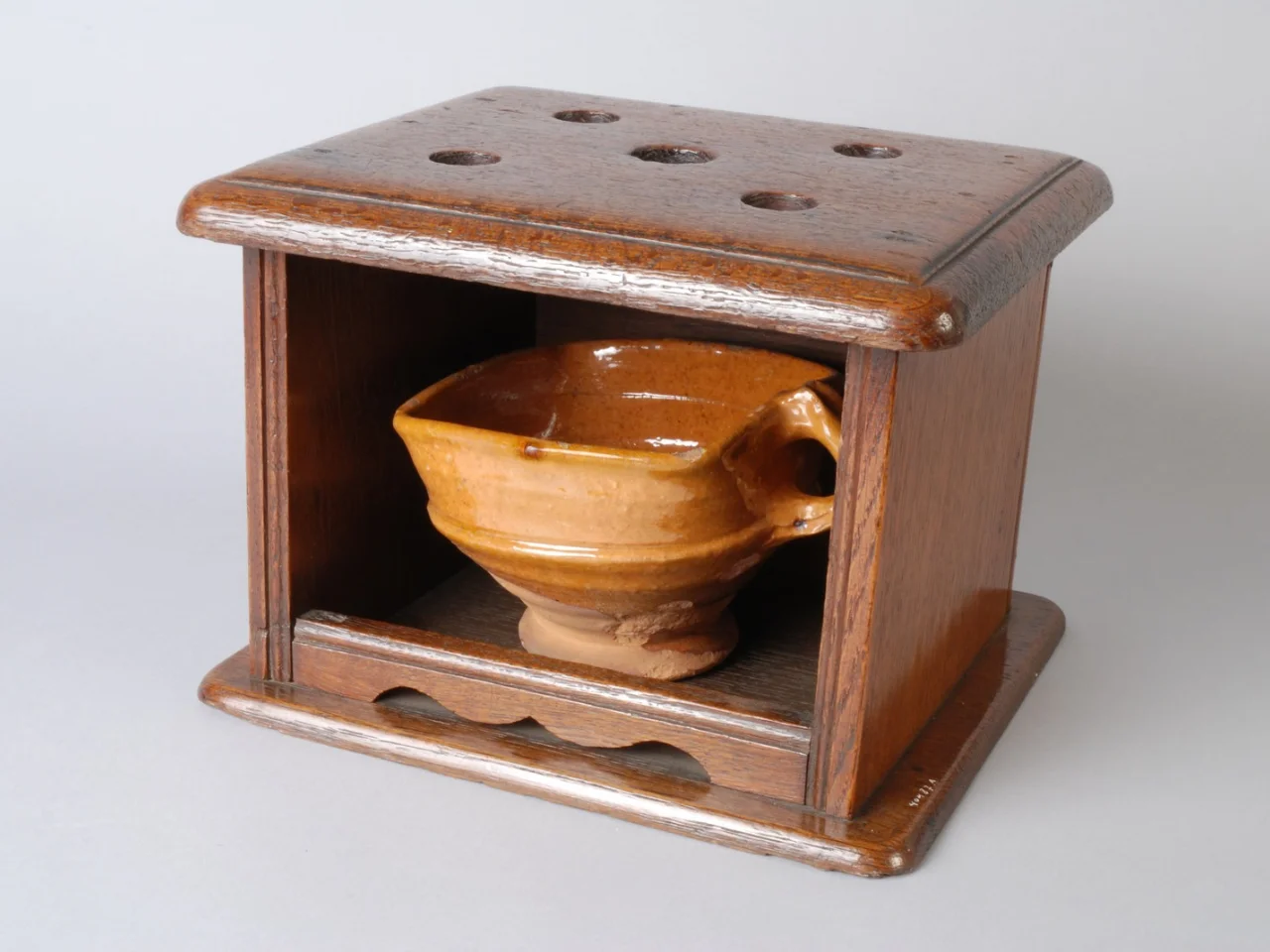
Where the hearth could not reach, people warmed the part of the body that felt the cold. The foot stove was once a familiar object across northern Europe. In the Netherlands, the wooden stoof held a small earthenware pot of embers beneath a perforated lid; women rested their feet upon it, and long skirts funnelled the rising warmth upwards. Vermeer’s The Milkmaid (c.1658) shows one on the floor in the lower right corner, and similar foot warmers later crossed the Atlantic to the unheated meeting houses of New England. Further east, the same principle took the form of a low table. The Japanese kotatsu, with roots in the Muromachi period, places a heat source beneath a table covered by a heavy quilt, so that a household can sit with their legs in the warm while the rest of the room stays cool. The korsi of Iran and Afghanistan works in much the same way, traditionally over a brazier of charcoal.
The masonry stove takes a different approach, storing heat instead of directing it. Hot gases from a short, fierce fire wind through a labyrinth of brick or tile flues, and the masonry absorbs the heat and releases it slowly for many hours afterwards. The Russian pech often carried a sleeping platform on top, and in 1767 the Swedes Carl Johan Cronstedt and Fabian Wrede refined the tiled kakelugn so that it burnt a fraction of the wood of earlier stoves. A bench built against such a stove was, and still is, the warmest seat in the house.
Lowering the thermostat suits many people, but not everyone. The UK Health Security Agency advises heating living spaces to at least 18°C, particularly for older people, babies, and anyone with heart or respiratory conditions, for whom cold rooms carry real risk. Very cool homes can also encourage condensation and damp. Hot-water bottles should be filled with hot rather than boiling water, used with a cover, and replaced if the rubber shows signs of perishing; many carry a date stamp in the small flower moulded on the neck.
None of this needs a masonry stove or a quilted table. A hot-water bottle and a set of thermals will let most households take a degree or two off the thermostat, and warmth kept close to the body depends a little less on the price of gas. For my own part, I have come to think the older habit of heating the person was the better one.