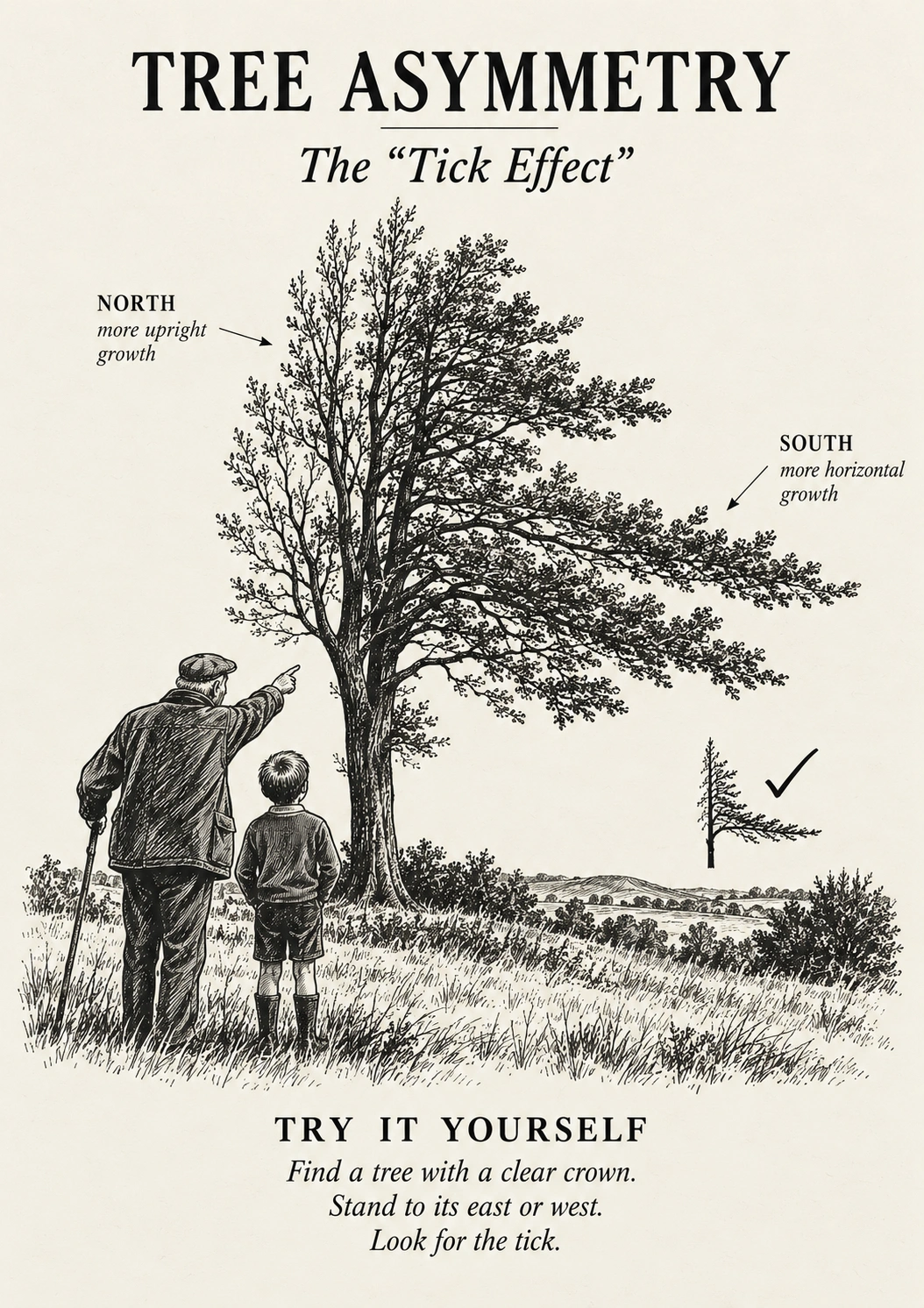
We tend to recognise a tree by its leaves, or perhaps by the texture of its bark. This time, stand back and consider its shape.
A tree’s crown carries a record of the conditions in which it has grown. Light plays its part, but so do the prevailing wind, neighbouring trees, old damage, and the lie of the land.
Tristan Gooley, the natural navigator, in his book ‘How to Read a Tree‘, describes a curious pattern he calls the ‘tick effect’. In the northern hemisphere, the southern side of a tree generally receives more direct sunlight. Given enough space, branches on this side tend to reach outwards, almost horizontally, towards the light; those on the shaded northern side tend to grow more steeply upwards. Viewed from the east or west, the silhouette can sometimes resemble a tick.
Of course, this is not a reliable way to find south. Any of those other influences can override it, and on an exposed coast the wind will often win. Treated as one clue amongst several, though, it gives you something to look for.
Find a tree with a clear crown (a lone oak in a field, perhaps, or a parkland beech). Stand far enough away to see its whole shape, then walk slowly around it, noticing which way the branches grow and at what angle.
Do you see the tick?