Right, let’s talk about your heating bill. And why you’re probably wasting most of it.
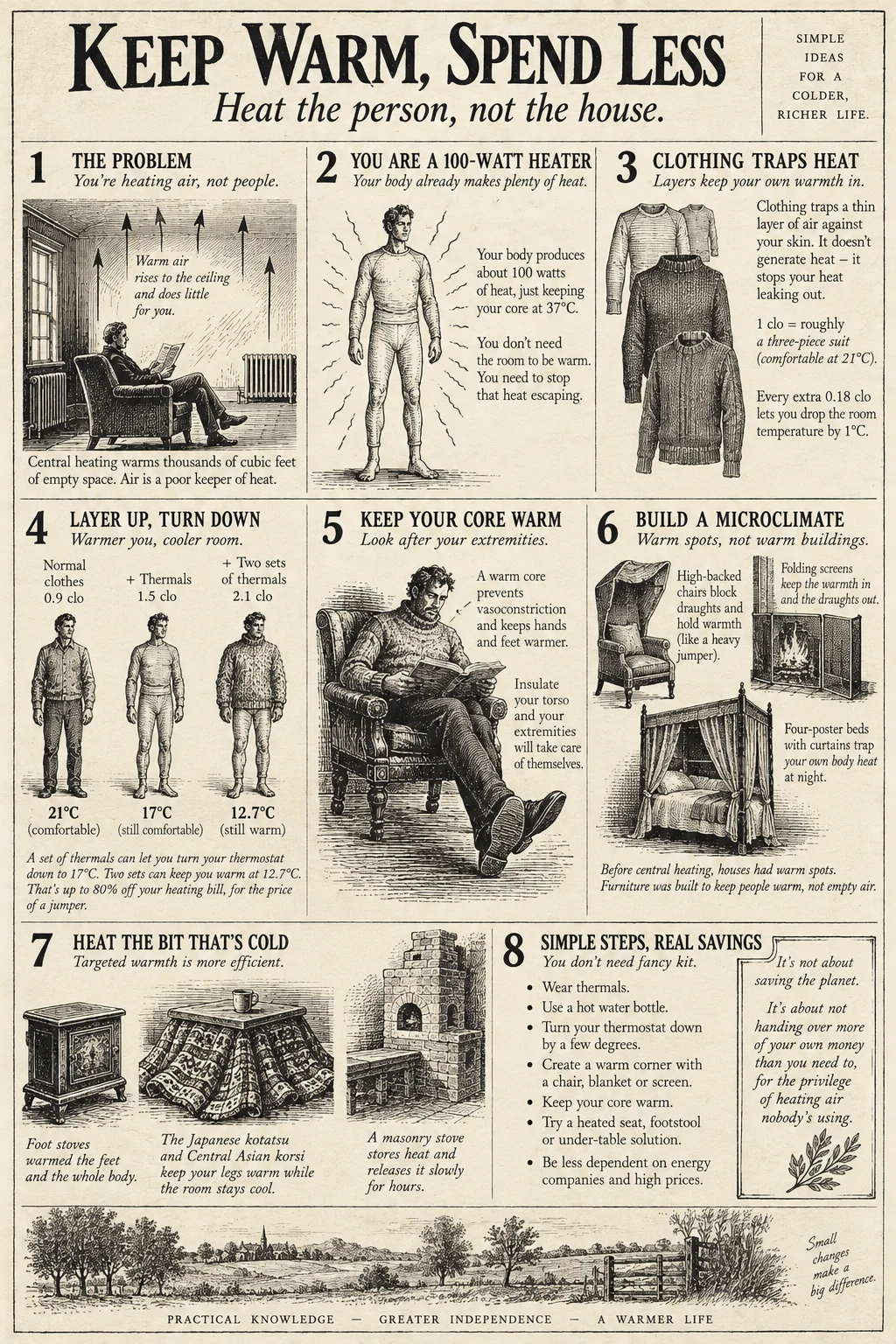
Central heating runs on a daft assumption: warm the entire room and the person sitting in it will be comfortable. But air’s rubbish at holding heat. You’re spending a fortune warming thousands of cubic feet of empty space, most of which floats straight up to the ceiling and does bugger all for you. Your ancestors didn’t have that luxury. They heated people, not buildings. And it worked.
You’re a 100-watt heater already
Your body is constantly pumping out about 100 watts of heat, all on its own, just keeping your core at 37°C. You don’t need the room to be warm. You need to stop that heat escaping.
That’s all clothing does, really. It doesn’t generate warmth. It traps a thin layer of air against your skin and stops your own heat from leaking out. There’s a unit for measuring this called a clo — one clo is roughly what a three-piece suit gives you, enough to keep you comfortable at 21°C. Every extra 0.18 clo of clothing you put on lets you drop the room temperature by about 1°C and still feel fine.
Put a set of thermal long johns and a top on, and you can turn your thermostat down to 17°C without shivering. Layer up with two sets of thermals under your normal clothes, and you’re looking at 12.7°C — room temperature that would’ve had you reaching for the boiler a minute ago — and you’ll still feel warm. That’s up to 80% off your heating bill, for the price of a jumper.
One more thing worth knowing: if your core’s properly insulated, your body doesn’t panic and cut off blood flow to your hands and feet, a reflex called vasoconstriction. Keep your torso warm and your extremities look after themselves. No need for fingerless gloves indoors like some Dickensian clerk.
Build yourself a microclimate
Before central heating, houses weren’t warm. They had warm spots. A fire in the corner, and everything built around directing that heat at the people who needed it, not wasting it on empty air.
The problem with a single fire is you get toasted on one side and frozen on the other, what’s called radiant asymmetry. So people built furniture to fix it. High-backed hooded chairs, lined with fabric, faced the fire and blocked the draught from behind, worth about the same as pulling on a heavy jumper. Folding screens did the same job around a dining table. Four-poster beds had curtains you’d draw shut at night, trapping your own body heat instead of losing it to a freezing bedroom.
That’s not nostalgia. That’s just better engineering than “turn the big dial up.”
Heat the bit that’s cold, not the whole room
Foot stoves — little perforated boxes with hot embers or hot water in them — sat under people’s feet, with long coats funnelling the rising warmth up the body. The Japanese kotatsu and the Central Asian korsi do the same trick: a low table, a heavy quilt, a heat source underneath, and the whole family sits with their legs in the warmth while the rest of the room stays cold and nobody cares.
And then there’s the masonry stove. Hot gases from a fire wind their way through a maze of brick flues, and the whole mass of brick soaks up that heat and radiates it out slowly for hours after the fire’s gone out. Build a bench against it and you’ve got the warmest seat in the house, running on a fraction of the fuel a modern boiler chews through.
It’s up to you
You don’t need a woodburner and a Central Asian table heater to use any of this. A hot water bottle, a decent set of thermals, and the willingness to turn your thermostat down two or three degrees will save you real money, and it makes you less dependent on whatever the energy company or the government decides to charge you this winter. That’s the actual point. Not saving the planet. Just not handing over more of your own money than you need to, for the privilege of heating air nobody’s using.
Nobody’s going to do this for you. Turn the dial down, put a jumper on, and see how you get on.