Listen to the audio version
For two thousand years, people ran their mills, saws and grinders straight off a river. Water turned a wheel, the wheel turned a shaft, the shaft turned the tool. No middleman.
Then electricity turned up, and now every hydro project defaults to it, as if it’s the only option. It isn’t, and in a lot of cases it’s the worse one.
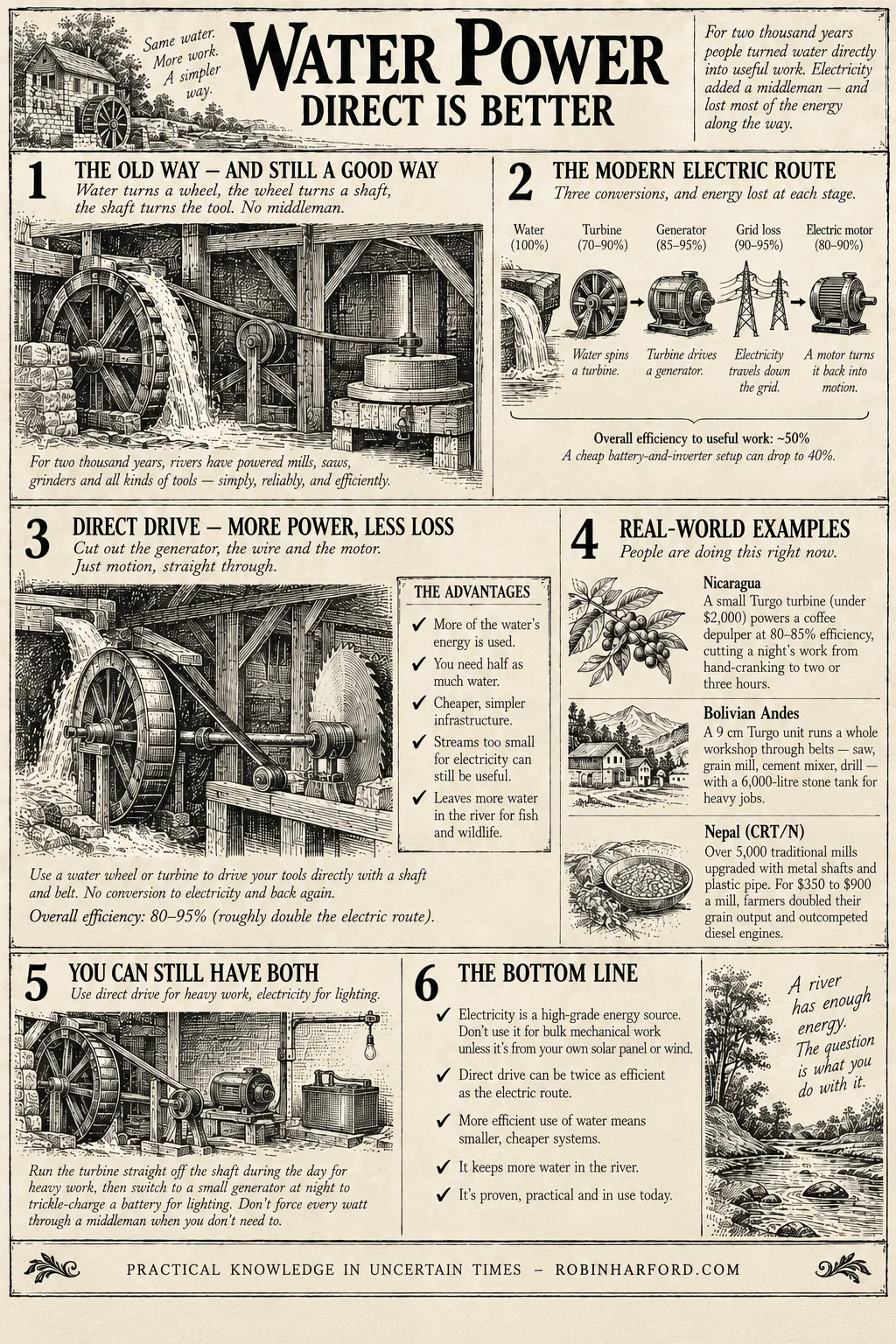
Electricity only becomes useful once something turns it back into motion — a motor spinning a saw blade, a pump, whatever. So the standard route is: water spins a turbine shaft, the turbine drives a generator, the electricity runs down a wire, a motor at the other end turns it back into motion. That’s three conversions, and every conversion bleeds energy as heat, friction and noise.
Add it up and a small home hydro system only gets about 50% of the water’s energy through to useful work once you count the generator, the wire and the motor at the end. A cheap battery-and-inverter setup can drop to 40%.
A top-of-the-line modern micro-hydroelectric setup is, on paper, no more efficient than a wooden water wheel built two thousand years ago. It’s actually worse than the iron water wheels blacksmiths were bolting together in the 1700s. All that progress, and we’ve built a system that loses more energy than our great-great-grandfathers did with wood and nails.
The direct alternative is to cut out the generator, the wire and the motor, and couple the water turbine straight to the machine’s drive shaft with a belt, the way an old mill worked, just with better engineering. No conversion to electricity and back — just motion, straight through. Do that and you get 80–95% efficiency depending on the turbine. Roughly double what the electrified version manages, off the exact same stream, same drop in height (that’s called the “head”).
Use the water twice as efficiently and you need half as much of it. Heavy steel pipework can be swapped for cheap flexible plastic tubing. Streams too small to bother with electrically can still turn a direct-drive setup. And pulling less water out leaves enough flow for the fish and everything else in the stream to actually survive.
People are doing this right now. In Nicaragua, coffee has to be depulped within a day of picking, work that used to mean hand-cranking a machine all night. A university team fitted a small water-powered motor, a Turgo, which is just a type of turbine shaped for a fast, small flow, for under two grand in parts. It runs at 80–85% efficiency and does a full night’s work in two or three hours.
In the Bolivian Andes, one 9-centimetre Turgo unit runs an entire workshop through belts: table saw, grain mill, cement mixer, drill, off a stream too small to power all of it at once. They built a simple 6,000-litre stone tank to store water for the heavy jobs, so the saw could run flat out in fifteen-minute bursts through the day.
In Nepal, a charity called CRT/N has upgraded over five thousand traditional wooden water mills, swapping wooden shafts for metal ones and wood chutes for plastic pipe. For $350 to $900 a mill, they doubled how much grain farmers can grind and undercut the diesel engines that were putting the old mills out of business.
None of this rules out electricity. Run the turbine straight off the shaft during the day for heavy work, then flip it over to a small generator at night to trickle-charge a battery for lighting. You just don’t force every watt through an inefficient middleman when you don’t need to.
We got so used to the idea that power means electricity that we stopped asking whether it needed to. The direct route worked for two thousand years before anyone had heard of a generator. Worth asking the question before defaulting to the wire.