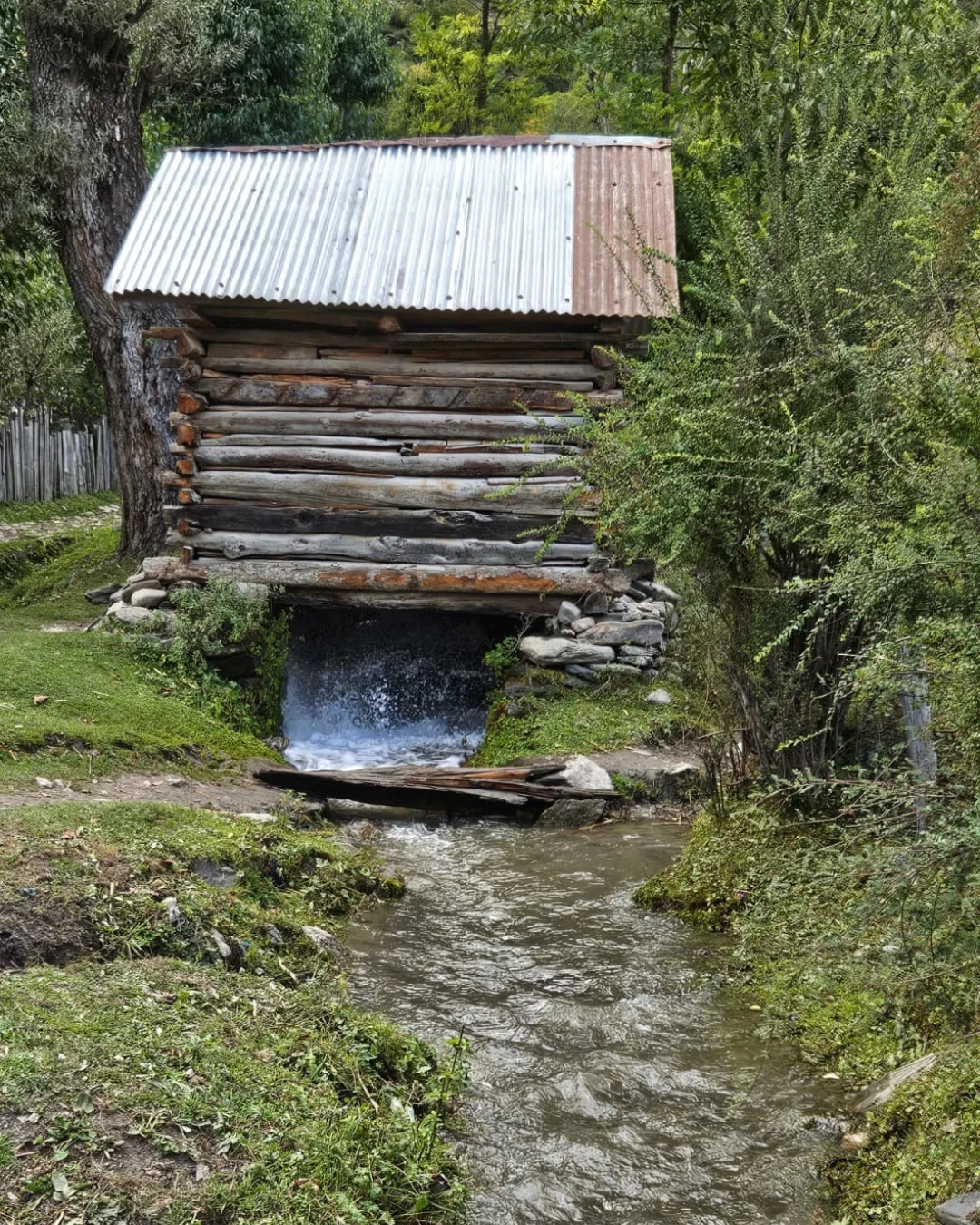
For the better part of two thousand years, water did its work without an intermediary. The Roman architect Vitruvius (c.80–c.15 BC) described a wheel turned by a stream’s current, its motion carried through wooden gearing to a pair of millstones. By 1086 the Domesday survey counted several thousand mills in England alone.
Electricity changed the default. Today almost every small hydro scheme is built to generate current, as though that were the only thing moving water could be asked to do. In a good many cases it may be the poorer choice.
Before electricity can spin a saw blade or drive a pump, a motor must turn it back into motion. The usual arrangement therefore runs through several stages. The water spins a turbine, the turbine drives a generator, the current travels down a cable, and a motor at the far end converts it back into motion. Each conversion loses a share of the energy as heat, friction, and noise.
Kris De Decker, writing in Low-tech Magazine in 2013, sets out the arithmetic. By his reckoning, a small domestic hydroelectric system delivers around half of the water’s energy as useful mechanical work once the electrical stages are counted. A cheaper setup running through batteries and an inverter might manage nearer 40 per cent.
In 1759 John Smeaton (1724–1792) presented his experiments on model water wheels to the Royal Society. He found that an undershot wheel, the kind Vitruvius described, returned only around a fifth of the water’s power. A well-made overshot wheel, fed from above, did far better: Smeaton’s figure was in the region of 60 per cent. The iron wheels of the nineteenth century improved on that again. Set against those figures, a modern micro-hydroelectric scheme used to drive machinery may do no better than the best work of a Georgian millwright.
The alternative is to leave out the electrical stages entirely and couple the turbine to the machine’s drive shaft, usually by a belt, much as the old mills did but with better engineering. Modern water turbines, a nineteenth-century invention, typically turn more than 85 per cent of the water’s energy into mechanical power at the shaft, so a direct-drive scheme can get roughly twice the useful work from the same stream and the same drop in height (the ‘head’). Equally, it can do the same work with about half the flow. Heavy steel pipework can give way to cheaper flexible plastic, and streams too small to justify an electrical scheme come within reach. More water also stays in the stream for the fish and the rest of its life.
Coffee growers in Nicaragua have put this to the test. The beans are harvested between December and February and must be depulped within a day of picking, work that once meant hours at a hand-cranked machine. In 2007 a team from Appalachian State University designed, built, and installed a direct hydro-powered depulper at Finca Esperanza Verde. Its turbine is a Water Motor model 90, made commercially by Campo Nuevo in Bolivia, with a 9-centimetre Turgo runner that converts water power into mechanical power at 80 to 85 per cent efficiency. A Turgo is a turbine shaped for small, fast jets of water. De Decker reports that the depulper ran without fault through five harvests.
The same Bolivian turbine drives a workshop high in the Andes, where De Decker describes a single unit running a table saw, grain mill, cement mixer, and drill through belts. The stream cannot power everything at once, so the builders added a 6,000-litre stone tank. It fills through the day and is released for the heavy jobs, allowing the saw to run at full power in fifteen-minute bursts.
Nepal’s traditional water mills, the ghatta, have followed a similar path. The Centre for Rural Technology, Nepal (CRT/N) has helped to upgrade thousands of them, replacing wooden shafts with metal and wooden chutes with plastic pipe, so that the old mills can hold their own against the diesel engines that were driving them out of business.
Of course, none of this rules out electricity. A turbine can drive machinery directly during the day and be switched over to a small generator at night, trickle-charging a battery for lighting. The generator becomes one tool on the shaft amongst others, used when it earns its place rather than by habit.