Listen to the audio version
I’ve always been interested and curious about how, as country people, we used to eat from the wild. I’m known for writing on wild edible plants, and yet I have a large amount of research notes collated over the years that branched out beyond plants and fungi into other food sources.
It was after I stayed in a forest in the north of Laos and went out hunting and gathering with the forest dwellers that I became intrigued by how local people fed themselves from the forest.
What comes next may feel a bit uncomfortable for some of you, disgusting even, because of the idea of eating hedgehog, which is a legally protected species. This is not an encouragement to do it. It is simply an acknowledgement and a reminder that the landscape and the biosphere nourished humans through many, many different sources that were available to the hunters and gatherers of the past.
I’m not one to avoid uncomfortable topics simply because they’re deemed not politically correct, because that feels like rewriting history, erasing aspects of history. By silencing, by erasing the knowledge, we erase the very cultures that used to participate in what to them was very definitely a culinary delight.
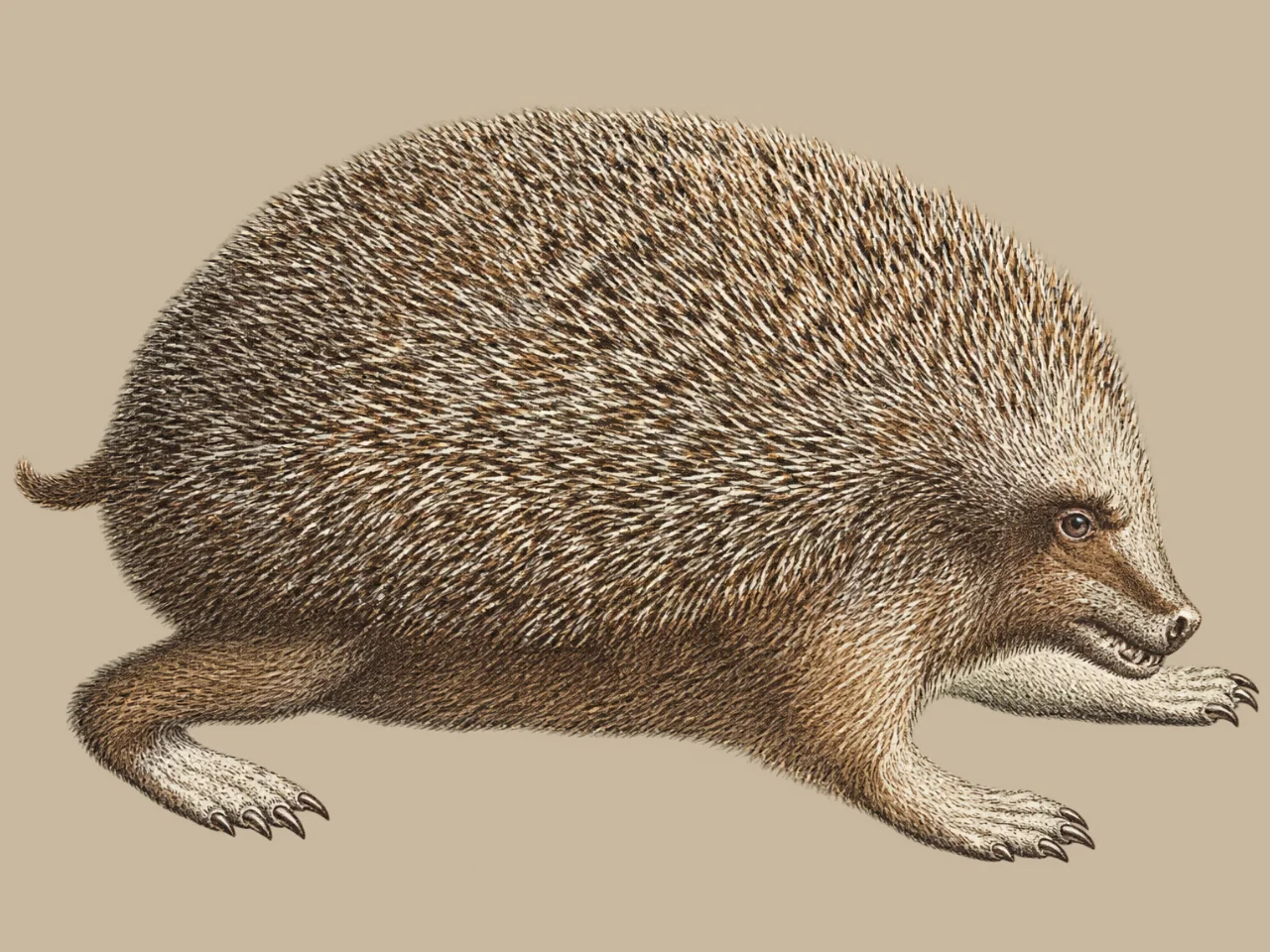
So let’s begin. There are few creatures as fondly regarded in the British countryside as the hedgehog, and what we don’t normally remember is that it was once considered good eating. Romany families knew hedgehog as hotchi or hotchi-witchi, and it was often compared to the flavour of quail; some also likened it to pheasant. The most popular way of cooking it was the Romany method.
The hedgehog was encased, with skin and spines intact, in a ball of clay, which was then placed in the glowing wood ashes or in a hole in the ground over which a fire was built. Once the clay had baked red, it was cracked open, and the spines and skin came away with the crust in a single piece. The meat beneath had been roasting in its own fat and an almost gravy-like sauce without charring. The clay served as oven, cooking pot, and plucking knife at once.
Some would cut away the bristles and sweal the animal instead, which meant singeing it with burning straw until the rind browned, much as a bacon pig was finished off. Others would simply skin it.
Either way, the hedgehog was split down the back, spitted on a pointed stick, and turned over the fire, and it was sometimes served with sage and onions, the same pairing that English cooks still give to pork. Romany cooks would sort hedgehogs by the colour of their fat, calling those with yellow fat ‘mutton hedgehogs’ and those with white fat ‘beef hedgehogs’.
They also knew when to gather hedgehogs. The time thought best was between September and January, traditionally around Michaelmas, when they were said to have fattened on fallen crab apples.
We should bear in mind that the early social chroniclers were generally white, affluent men who often romanticized outsider cultures. Hedgehogs feed chiefly on beetles, caterpillars, earthworms, and slugs, with fruit playing only a minor part in their diet, so this report may be somewhat embellished.
Nevertheless, the timing is sound, because hedgehogs lay down fat before hibernation, so an animal taken at Michaelmas would certainly be at its heaviest. Some families didn’t leave that fattening to chance: young hedgehogs were sometimes flitted, which meant tethered by the hind legs so they could forage and put on weight.
There’s one report from Long Compton, on the Warwickshire edge of the Cotswolds, where a farming family went further: it’s recorded that they actually bred hedgehogs in captivity and dressed them like poultry. Yet hedgehog was never just a food of the hedgerow or the campfire. It also found its way onto more refined tables.
For instance, Le Ménagier de Paris, a French household manual of around 1393, tells us that the cook would cut the animal’s throat, skin and dress it, press it in a dry towel, and then truss it like a chicken. It was then roasted and served with cameline, a popular medieval European sauce made from bread soaked in vinegar and wine, heavily spiced with cinnamon, ginger, cloves, and sugar.
Alternatively, it was sometimes baked in pastry with a sauce often used for duckling. Elsewhere on the Continent, hedgehog pie was admired, and French foresters are said to have stewed hedgehog with morels.
If we go beyond the kitchen and into the apothecary’s cabinet, we find in William Salmon‘s New London Dispensatory, a popular apothecary’s handbook reprinted through the 1690s and 1700s that hedgehog ashes were used as a remedy for dropsy and for bedwetting (or, as they delightfully put it, ‘not holding the water’).
Older writers advised people to pour the melted dripping of a roast hedgehog into a deaf ear and to stop it with black wool. However, there’s no evidence that either remedy worked, and animal fat in the ear could certainly cause infection. So it is not a recommended practice.
Today, however, the picture is very different. The West European hedgehog (Erinaceus europaeus) is protected in Britain under Schedule 6 of the Wildlife and Countryside Act 1981, which prohibits killing or taking it by methods such as traps and nets. It’s also classed as Vulnerable on the Red List for Britain’s Mammals, and its numbers have fallen sharply in the countryside.
The hotchi-witchi of the Romany hearth and the hedgehog we now work to protect are the same animal, and yet remembering how it was once eaten is not an invitation to repeat the practice (not unless there’s an apocalypse, in which case I think the laws are basically going to become obsolete).
Rather, it recovers what people knew of its habits, its seasons, and the conditions that were optimal for eating it. It is also a reminder, regardless of our sensitivities, that people from bygone eras were very close to the land and their place, and that relationship informed their cultural practices.
References
Cuttriss, F. (1915). Romany Life: Experienced and Observed During Many Years of Friendly Intercourse with the Gypsies. Mills & Boon Limited.
Fernie, W. T. (1905). Meals medicinal with herbal simples (of edible parts) curative foods from the cook—In place of drugs from the chemist. J. Wright.
Hall, G. (1915). The Gypsy’s Parson: His Experiences and Adventures. Sampson Low, Marston & Co. Ltd.
Seba, A. (1734). Locupletissimi rerum naturalium thesauri accurata descriptio, et iconibus artificiosissimis expressio, per universam physices historiam: Opus, cui, in hoc rerum genere, nullum par exstitit (Vols 1–4). J. Wetstenium, Gul. Smith & Janssonio-Waesbergios. Biodiversity Heritage Library.
Simmonds, P. L. (1885). The animal food resources of different nations, with mention of some of the special dainties of various people derived from the animal kingdom. E. & F.N. Spon.
Wright, T. (1862). A History of Domestic Manners and Sentiments in England During the Middle Ages. Chapman and Hall. Project Gutenberg.
Wroot, A. J. (1984). Feeding Ecology of the European Hedgehog Erinaceus europaeus [PhD thesis, Royal Holloway, University of London]. EThOS – British Library.