You can sometimes see the direction of the prevailing wind without feeling a breath of it.
Look at the trees.
Where wind blows repeatedly from the same direction, its effects accumulate over years. On exposed ground, whole groups of trees may be shaped by it. Individual trees can carry the same evidence in their branches and roots.
There are several signs worth looking for.
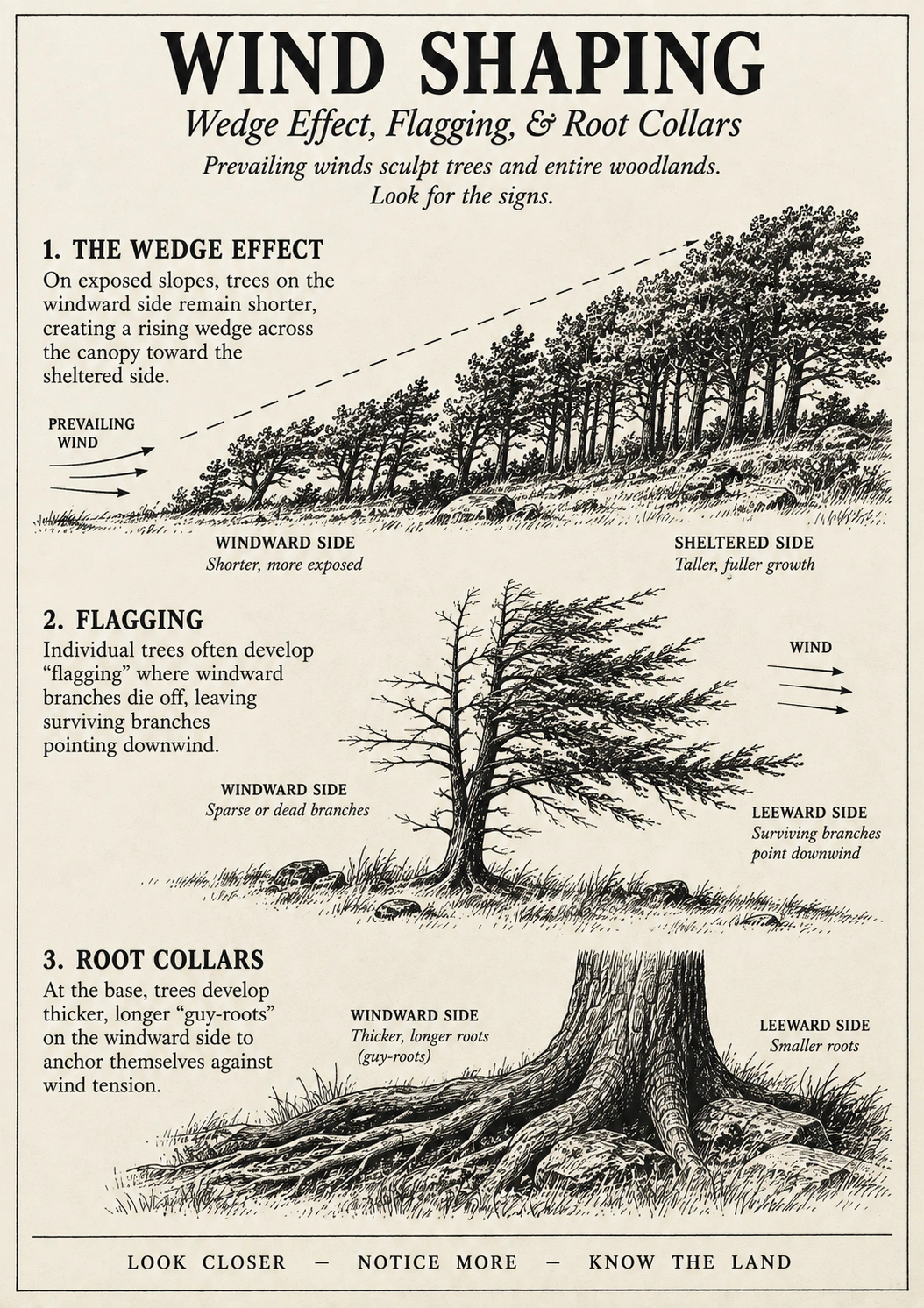
On the edge of a woodland, trees facing the prevailing wind may be shorter than those growing behind them. Seen from a distance, the canopy rises towards the more sheltered side. This is sometimes called the ‘wedge effect’.
A solitary tree may show something different. Branches on the exposed side can be sparse or damaged, while growth extends more strongly downwind. This is known as ‘flagging’.
Then look down.
At the base of the trunk, you may find larger roots extending into the windward side, helping the tree resist the forces acting upon it.
None of these signs should be read on their own. Species, exposure, neighbouring trees, slope and local conditions can all affect what you see.
Find somewhere exposed and spend a while looking at the trees.
Which way has the wind been blowing?